DASTA Marks 10 Years of STMS, Pushes Exit Strategy for 120 Localities to Manage Tourism
DASTA celebrates 10 years of STMS and prepares to hand over tourism management to 120 local administrations via an Exit Strategy to tackle climate change.
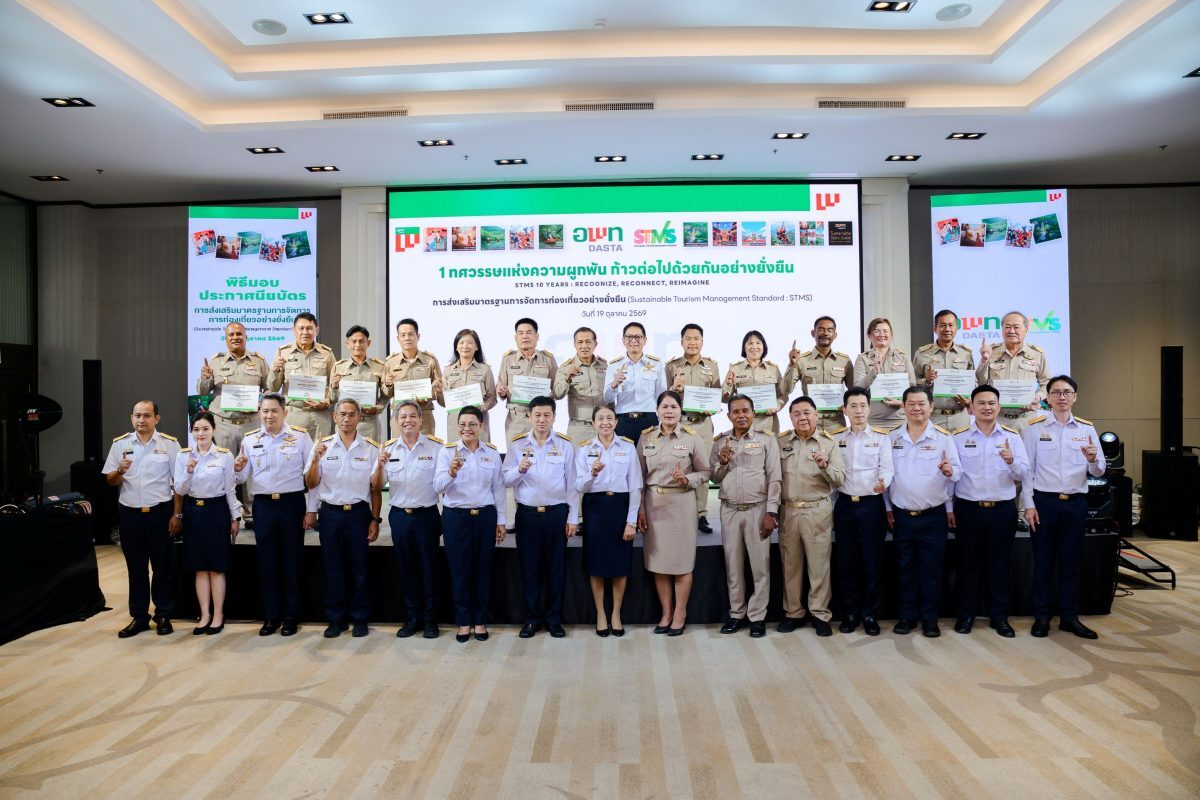
The Designated Areas for Sustainable Tourism Administration (Public Organization), or DASTA, recently held an event celebrating the 10th anniversary of the Sustainable Tourism Management Standard, or STMS, at TK Palace Hotel & Convention, Bangkok under the theme STMS 10 Years: Recognize Reconnect Reimagine. Announcing a new direction for the next decade, DASTA is preparing to hand over tourism management roles to local administrative organisations that are ready to look after themselves through its Graduation Plan and Exit Strategy concepts, while highlighting climate change adaptation as a key agenda for future development.
The Past 10 Years: From 107 to 120 Localities
Mr Siripakorn Cheawsamoot, Director-General of DASTA, revealed that since 2016, DASTA has collaborated with the Department of Local Administration and network partners to develop the capacity of local administrative organisations to manage tourism systematically. STMS is a standard recognised by the Global Sustainable Tourism Council, or GSTC, and can be built upon towards international standards. Over the first 9 years, a cumulative total of 107 localities passed the standard, and in 2026 another 13 were added, expanding the STMS network to 120 localities covering 22 provinces nationwide.
Mr Siripakorn stated that passing the STMS criteria requires actual operational results, not merely attending training sessions. This standard is like the first button fastened that localities can build upon towards international standards, but the most important aspect is applying the standard to generate genuine benefits for local residents.
Opening the Way for the Exit Strategy for Localities to Shape Their Own Future
For the new decade, DASTA will move forward in selecting high-potential areas from the 120 localities to hand over management for the localities to operate independently, while DASTA continues to support knowledge and collaborative networks behind the scenes. Each area does not need to share the same goal; some focus on generating income, while others prioritise the quality of life of local residents, with local people themselves determining the direction of development.
Another major challenge is adapting to climate change, including heavy rainfall, flash floods and extreme heat affecting tourist safety. Localities must therefore adjust activity formats, such as scheduling activities in the morning or evening, preparing indoor activities to accommodate unseasonal rain, and planning emergency responses in advance. Mr Kookiat Nimniam, Chief Inspector-General of the Department of Local Administration, Ministry of Interior, added that development must begin from within the community itself, because relying solely on state support may prove unsustainable once that support ends.
Lessons from 3 Model Localities
During the event, lessons were shared from 3 localities. Nan Town Municipality, which has passed the STMS since 2016, focuses on building participation among town residents, sorting waste until up to 95% can be reutilised, and developing a walking street that generates local economic circulation every week. Khao Chaison Subdistrict Administrative Organisation in Phatthalung Province developed natural hot springs into a wellness tourism attraction in collaboration with educational institutions. Meanwhile, Kok Sathon Subdistrict Administrative Organisation in Loei Province organised a tour vehicle system for viewing wild Himalayan cherry blossoms at Phu Lom Lo, while deducting 10% of tourism revenue into a central fund to plant approximately 1,000 additional wild Himalayan cherry trees per year.
| Details | Information |
|---|---|
| Venue | TK Palace Hotel & Convention, Bangkok |
| Event Theme | STMS 10 Years: Recognize Reconnect Reimagine |
| Cumulative STMS Network | 120 localities in 22 provinces |
| Localities Newly Certified in 2026 | 13 localities in 6 provinces: Chiang Rai, Phatthalung, Loei, Trat, Chonburi and Samut Prakan |
This news is of interest to executives of local administrative organisations and community-based tourism event organisers seeking sustainable management guidelines, as well as hotel professionals and tourism operators in STMS network areas who can adapt the case studies from Nan, Khao Chaison and Kok Sathon to plan for climate change adaptation in their own businesses.