Betagro Develops SPY EGG to Reduce Egg Transport Damage by 8.7 Million Eggs per Year
Betagro Public Company Limited developed the SPY EGG simulated egg to detect impacts in conveyor and transport systems, reducing egg damage by 8.7 million eggs per year.
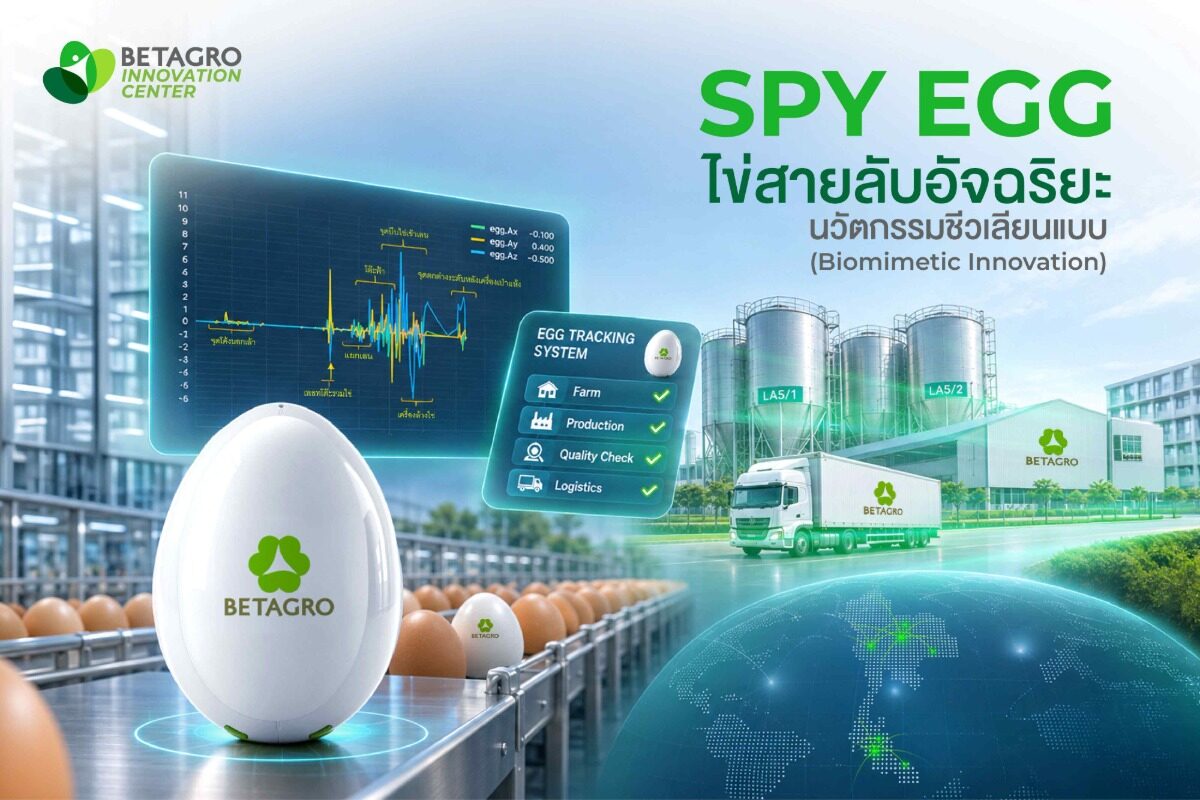
Betagro Public Company Limited or BTG, an integrated Thai food business operator, unveiled its smart simulated chicken egg innovation, SPY EGG, on 9 November 2026 to elevate chicken egg quality control across its domestic production and transport chain. This innovation was developed from the concept of biomimicry, or Biomimetic Innovation, which integrates sensor and IoT systems to measure impacts and compression at risk points invisible to the naked eye. Deploying the device in real operations from egg collection centres through to delivery helps reduce egg losses by up to 8.7 million eggs per year, representing an economic value of more than 35 million baht per year.
Solving Egg Loss through Engineering Systems
Data from egg collection centres in 2025 indicated that Betagro had to withdraw damaged chicken eggs from sale amounting to around 4 per cent of domestic deliveries, totalling up to 64 million eggs per year, or a value of more than 200 million baht. The causes of damage occurred across three key stages of the supply chain: upstream around the grading machines at production sites and egg collection centres, midstream during transport on delivery vehicles where braking or hitting potholes on the road may occur, and downstream during the packing process. To solve this problem, the working team developed SPY EGG under the concept 'To Truly Understand Egg, We Need to be The Egg', with a size and weight of 65 to 75 grams, equivalent to No. 0 and No. 1 chicken eggs, to move alongside real eggs and transmit data in real time.
The success of SPY EGG resulted from collaboration among three main departments: the Material Science & Technology Department from the Innovation Office, the Automation & IOT Support Department from the Central Engineering Office, and the Egg Collection Centre from the Livestock Business Line. The three departments jointly developed a materials-science artificial eggshell formula capable of absorbing impacts like a real eggshell, equipped with a microcontroller, a sensor system and an algorithm to convert vibrations into engineering data. Testing the device across the actual production line enabled the team to pinpoint up to 6 risk points along the conveyor belt, including belt joints, conveyor transfer points and locations where compression occurs during transport, allowing machinery to be modified with precision.
Sustainability Outcomes and Benefits for the Food Service Sector
Upgrading the production process with data from SPY EGG has generated a return on investment of up to 7 times and helped preserve chicken egg quality so that shipments reach their destination intact. In addition, it reduces Food Waste and curbs the loss of resources including animal feed, water and energy across the supply chain, cutting greenhouse gas emissions by approximately 800 tonnes of carbon dioxide equivalent per year, comparable to planting around 36,000 trees. These achievements across both business and sustainability dimensions earned Betagro the SET Awards 2026 in the Innovative Company Awards category under the Outstanding Innovative Company Awards group.
| Details | Information |
|---|---|
| Innovation Owner | Betagro Public Company Limited or BTG |
| Release Date | 9 November 2026 |
| SPY EGG Specifications | Smart simulated chicken egg weighing 65 to 75 grams (equivalent to No. 0 and No. 1 chicken eggs) |
| Areas of Application | Egg collection centres, conveyor belt systems and transport systems to final destination |
| Loss Reduction Achieved | 8.7 million eggs per year worth over 35 million baht per year (7 times return on investment) |
| Environmental Outcome | Reduces greenhouse gas emissions by approximately 800 tonnes of carbon dioxide equivalent per year |
| National Award | SET Awards 2026, Innovative Company Awards category (Outstanding Innovative Company Awards group) |
This advancement in food innovation is of particular interest to hotel food and beverage professionals, restaurant operators and event organisers who source high-quality ingredients for catering. Having a precise ingredient quality control system from the point of origin through transport reduces the risk of damaged produce and maintains freshness standards before reaching the kitchen. At the same time, it aligns with the priorities of modern event organisers and travellers who place importance on reducing Food Waste and supporting environmentally sustainable businesses.